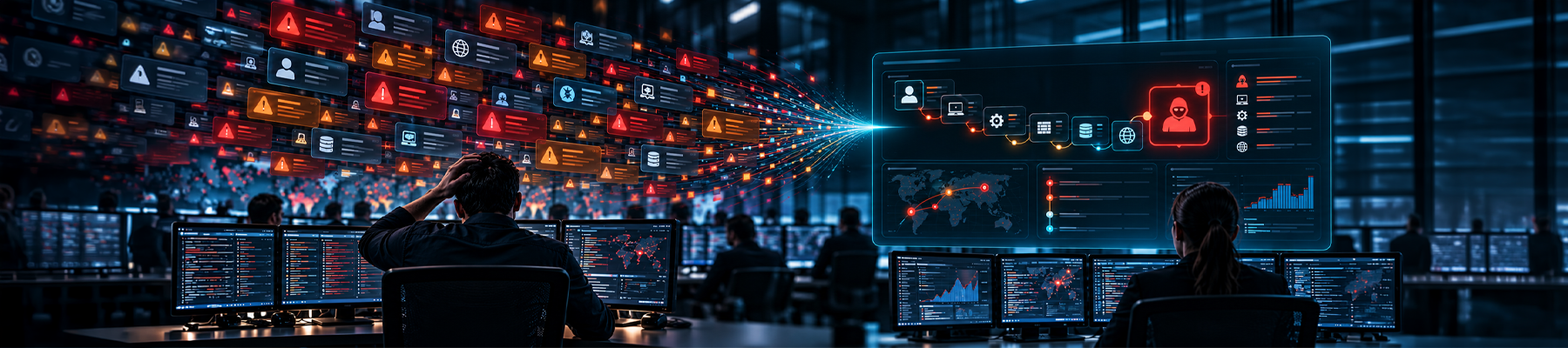



Why throwing more AI at cybersecurity makes things worse — and what a "decision layer" architecture looks like instead.
There's a reflex in cybersecurity right now that goes something like this: "Attackers have AI. We need more AI."
It sounds reasonable. It's also wrong — or at least, dangerously incomplete.
Running powerful AI systems like Mythos across an entire enterprise environment isn't just expensive. It produces a flood of findings no team can act on, surfaces vulnerabilities without business context, and quietly degrades the very thing it was meant to improve: decision quality.
The problem isn't that we have too little AI in security. It's that we have AI in the wrong places, with no layer above it deciding when to trust it, when to override it, and when to ignore it altogether.
Before talking about solutions, it's worth being honest about why "AI everywhere" doesn't work in practice. Three constraints break it:
Running AI like Mythos across full environments — every asset, every application, every code repository, continuously — is not financially sustainable for most organizations. The compute alone outpaces the security budget, and the marginal value of the thousandth scanned asset is rarely worth what it costs to scan it.
The faster AI finds vulnerabilities, the faster the remediation queue grows. If you 10x the rate of discovery without changing the rate of fix, you don't get safer — you get a longer backlog and a more demoralized team. Volume becomes its own form of denial of service against your own operations.
Generic vulnerability lists don't tell you what matters to your business. A CVSS-9 in a sandboxed test environment is not the same risk as a CVSS-7 in a system handling regulated customer data. AI that doesn't know which of your assets are crown jewels will treat them all the same — and that's worse than no AI at all, because it creates the illusion of prioritization.
The fix isn't less AI. It's a layer above the AI that decides where AI should run.
This is the role Regiment AI plays in the Invinsense architecture. It's not another detection engine, scanner, or model. It's a decision-making layer that sits across exposure, detection, and compliance and continuously evaluates three questions:
The output isn't more raw signal. It's structured intelligence — context-aware decisions about where machine intelligence is genuinely additive, where simple rules are faster and more reliable, and where the right action is no action at all.
The principle is uncomfortable but correct:
AI should not be everywhere. It should be exactly where it matters.
The contrast becomes obvious once you see it side by side.
Without a decision layer:
With a decision layer:
This is the difference between an AI-powered SOC that produces a thousand "critical" alerts a day and one that produces a dozen — and is right about all of them.
Once you have a decision layer, the question of where to run Mythos answers itself. You don't run it across everything. You run it where it earns its cost:
Everything else gets handled by faster, cheaper, deterministic checks. The decision layer is what makes that triage possible without creating blind spots.
Most security platforms are still being marketed on the promise of more: more detections, more coverage, more automation, more AI. That promise made sense when the bottleneck was visibility. It doesn't make sense now.
The bottleneck today is decision quality under pressure. When AI-driven attackers are operating at machine speed, the defender who wins isn't the one with the most signal — it's the one whose architecture can decide, fast and correctly, which signal to act on, which to suppress, and which to escalate to a human.
A decision layer is what makes that possible. Without it, AI in security is just a faster way to generate work you can't finish.
Cybersecurity doesn't need more AI everywhere. It needs the right AI in the right places, governed by a layer that knows the difference. That's not a feature — it's an architectural choice. And it's quickly becoming the line between programs that scale into the Mythos era and programs that quietly buckle under their own telemetry.
Put AI exactly where it matters. Let everything else stay deterministic. And put a decision layer in charge of telling the two apart.
Download our whitepaper, where we explore Mythos-ready security with Invinsense.
We are also hosting a webinar on this, which you can sign up for by clicking on the link.
Discover complete cybersecurity expertise you can trust and prove you made the right choice!